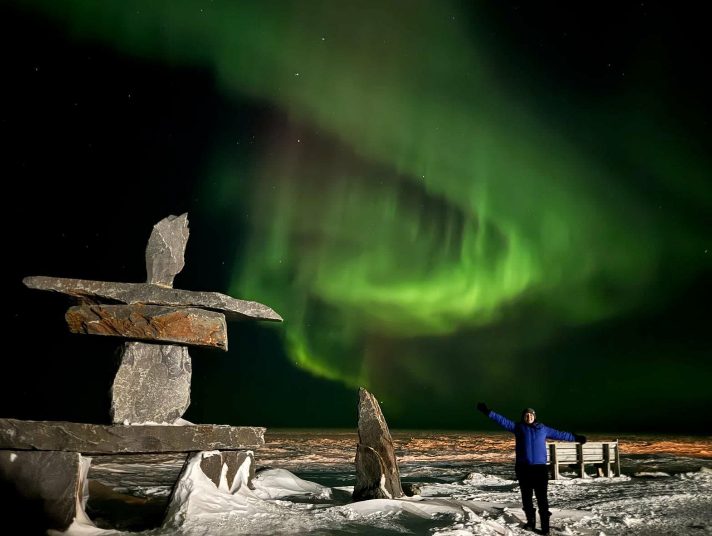
Tell us a bit about yourself.
My name is Kiersten King, and I am a Canadian doctoral student at the University of Manitoba. I earned a Bachelor of Science in Zoology from the University of Guelph in 2021, where I discovered my passion for polar bear research. I earned a Master of Science in Biology from York University in 2023, studying polar bear dietary habits in a changing climate. Now, as a PhD student at the University of Manitoba, I research polar bear reproductive investment strategies and how climate change may alter maternal investment in cubs.
How did you find out about NNOCCI?
I initially learned about NNOCCI through an organization that I work very closely with, Polar Bears International. My colleague at Polar Bears International forwarded me an email with the application information for the first-ever Canadian version of the NNOCCI Framing the Conversation Course, which was funded by a US Embassy of Canada grant. I applied to participate, and my application was selected!

What was Framing the Conversation: A Crash Course in Effective Climate Change Communication like as a Canadian?
I very much enjoyed taking the course! I believe our course was a great learning experience for both the participants and the teaching team. Although the content was consistent with previous courses, what differed was the accessibility of the resources and examples for Canadians. Many of the resources offered did not have a Canadian equivalent, or if they did, were unknown to NNOCCI at the time. Similarly, many of the examples were US-based, which was still helpful, but many of us felt that having Canadian examples might have helped us connect more closely to the material. Following the course, I had the opportunity to provide feedback and additional resources to help NNOCCI update the course material to reflect some amazing Canadian resources, examples, and perspectives. It has been so wonderful to see NNOCCI expand from a National to an International organization!
How do NNOCCI tools influence your work?
I use tools from NNOCCI in all aspects of my work. As a graduate student, I ensure my manuscripts and dissertation are framed as effectively as possible. Scientific writing can be challenging, but I strive to keep my work accessible and clearly describe how climate change affects polar bears in western Hudson Bay. If you’re interested in learning more, I’ve included links to some of my work:
- Climate-linked evolution and genetics in a warming Arctic
- Evaluating the extent and drivers of dietary specialization in polar bears (Ursus maritimus) across Western Hudson Bay
I also showcase my NNOCCI training through my work with Polar Bears International. As a Field Ambassador, I connect with people worldwide about climate change, polar bears, and the threat of sea ice loss. Polar Bears International depends on strong framing to make our climate change communications effective and inspire action.
What is your involvement in NNOCCI?
Since completing the 2024 course, I have co-hosted an introductory NNOCCI webinar (Introduction to Effective Climate Change Communication), served as a Teaching Assistant for the Framing the Conversation course, and became the first Canadian member of the NNOCCI Governing Council. I currently serve on the Science and Evaluation Committee, the Events Subcommittee, and as Regional Leader for Canada and Alaska. A few weeks ago, I also became the first Canadian Trainer for NNOCCI, co-facilitating the Framing the Conversation course. I am so grateful to NNOCCI for allowing me so many opportunities to represent and support climate change communication in Canada!
 Climate Emotions: Helpless Or Hopeful?Climate Emotions: Helpless Or Hopeful? by Heidi Zamzow, April 17 2019 With the recent IPCC warning that we may have perhaps a dozen years before we encounter severe and irreversible impacts of climate change, it comes as little surprise that a recent survey* in climate communications research indicates 7 in 10 people in the U.S. are concerned [READ MORE]
 Introducing The Climate Action ToolkitIntroducing the Climate Action Toolkit A Q&A with Bailey Robbins The Climate Action Toolkit can be found on this page. Feel free to download the toolkit for printing and sharing. If you want to learn more about the toolkit, join us for NNOCCI Presents: Cutting Through the Tension, a webinar on Tuesday, September 15 from 3-4PM ET/ 12-1PM PT. [READ MORE]
 Cut through Confusion with Appeals to Protection and ResponsibilityCut through Confusion with Appeals to Protection and Responsibility September 07 2016 This is the third in a series about framing ocean and climate change. Advocates and experts are familiar with common—but often untrue—tropes about our environment. How can we cut through them and communicate in a way that deepens understanding about the complex [READ MORE]
 Angling Toward Solutions in Climate Change EducationAngling Toward Solutions in Climate Change Education John Anderson, September 21 2016 Our global community is confronting a significant opportunity to change. We understand that protecting what matters to our families: our health and security, special places we care about, and living creatures with whom we share this planet (people and non-human [READ MORE]
 Seattle Aquarium Hope ObjectsSeattle Aquarium Hope Objects Nicole Killebrew Nicole Killebrew is a 2011 NNOCCI Alum and Training Committee member. In August 2024, the Seattle Aquarium opened a new space, Ocean Pavilion. The entire building is a celebration of the Coral Triangle, an epicenter of marine biodiversity in the heart of the Indo-Pacific. While the animals and [READ MORE]