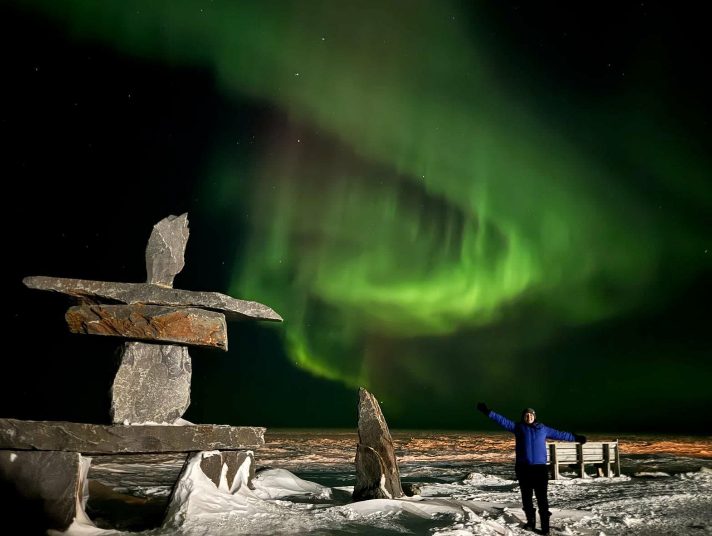
Tell us a bit about yourself.
My name is Kiersten King, and I am a Canadian doctoral student at the University of Manitoba. I earned a Bachelor of Science in Zoology from the University of Guelph in 2021, where I discovered my passion for polar bear research. I earned a Master of Science in Biology from York University in 2023, studying polar bear dietary habits in a changing climate. Now, as a PhD student at the University of Manitoba, I research polar bear reproductive investment strategies and how climate change may alter maternal investment in cubs.
How did you find out about NNOCCI?
I initially learned about NNOCCI through an organization that I work very closely with, Polar Bears International. My colleague at Polar Bears International forwarded me an email with the application information for the first-ever Canadian version of the NNOCCI Framing the Conversation Course, which was funded by a US Embassy of Canada grant. I applied to participate, and my application was selected!

What was Framing the Conversation: A Crash Course in Effective Climate Change Communication like as a Canadian?
I very much enjoyed taking the course! I believe our course was a great learning experience for both the participants and the teaching team. Although the content was consistent with previous courses, what differed was the accessibility of the resources and examples for Canadians. Many of the resources offered did not have a Canadian equivalent, or if they did, were unknown to NNOCCI at the time. Similarly, many of the examples were US-based, which was still helpful, but many of us felt that having Canadian examples might have helped us connect more closely to the material. Following the course, I had the opportunity to provide feedback and additional resources to help NNOCCI update the course material to reflect some amazing Canadian resources, examples, and perspectives. It has been so wonderful to see NNOCCI expand from a National to an International organization!
How do NNOCCI tools influence your work?
I use tools from NNOCCI in all aspects of my work. As a graduate student, I ensure my manuscripts and dissertation are framed as effectively as possible. Scientific writing can be challenging, but I strive to keep my work accessible and clearly describe how climate change affects polar bears in western Hudson Bay. If you’re interested in learning more, I’ve included links to some of my work:
- Climate-linked evolution and genetics in a warming Arctic
- Evaluating the extent and drivers of dietary specialization in polar bears (Ursus maritimus) across Western Hudson Bay
I also showcase my NNOCCI training through my work with Polar Bears International. As a Field Ambassador, I connect with people worldwide about climate change, polar bears, and the threat of sea ice loss. Polar Bears International depends on strong framing to make our climate change communications effective and inspire action.
What is your involvement in NNOCCI?
Since completing the 2024 course, I have co-hosted an introductory NNOCCI webinar (Introduction to Effective Climate Change Communication), served as a Teaching Assistant for the Framing the Conversation course, and became the first Canadian member of the NNOCCI Governing Council. I currently serve on the Science and Evaluation Committee, the Events Subcommittee, and as Regional Leader for Canada and Alaska. A few weeks ago, I also became the first Canadian Trainer for NNOCCI, co-facilitating the Framing the Conversation course. I am so grateful to NNOCCI for allowing me so many opportunities to represent and support climate change communication in Canada!
 To Frame Climate Change, Lead with a Researched Value—Not a “Rogue” OneTo Frame Climate Change, Lead with a Researched Value—Not a “Rogue” One January 20 2017 This is the sixth post in a series about framing ocean and climate change. So, you want to motivate the public to take action to address climate and ocean change? One of the most important communications moves you can make is to open with a broad statement [READ MORE]
 Building a Better Tomorrow with NNOCCI’s Simone MortanBuilding a Better Tomorrow with NNOCCI’s Simone Mortan Written by Megan Stouffer The United States is 250 years old this year. Along with the pomp and circumstance of the celebration, there are those who may feel discouraged by many moments in our country’s history—moments that don’t feel worth celebrating or honoring. We recognize that some [READ MORE]
 IMPORTANT UPDATE: Federal Funding for NNOCCI TerminatedWe wanted to alert you of a significant event that is impacting our team and work. We received notice earlier this month that our active 2-year grant through the US Embassy in Canada (a part of the US State Department) has been terminated effective immediately. While the details provided by the State Department are extremely minimal, it is almost certainly connected with the recent decisions by the new administration to cut funding for all international partnerships and eliminate funding aimed at climate. [READ MORE]
 Museums Mobilizing Climate ActionMuseums Mobilizing Climate Action Billy Spitzer, August 06 2018 (Excerpted from a commencement speech for the Harvard Extention School Museum Studies Program) The Role of Museums In Tackling Climate Change At the New England Aquarium, I spend most of my time working at the intersection of museums and sustainability. About 10 years ago, we realized [READ MORE]
 My Community is My Hope #100HopefulDaysMy Community is My Hope #100HopefulDays Sarah-Mae Nelson, MS, CIG/CIT, February 03 2017 Today I turn 37 years old. This seems like an impossible number. In my mind, I am a vibrant 21-year-old eager to make the world a better place. I see opportunities to make a positive difference everywhere. I am young, I am empowered, and I am unstoppable. In [READ MORE]