The United States is 250 years old this year. Along with the pomp and circumstance of the celebration, there are those who may feel discouraged by many moments in our country’s history—moments that don’t feel worth celebrating or honoring. We recognize that some of us feel a little hopeless right now. And while we can’t go back in time to right some wrongs, we can uplift some of the movements and moments that remind us a better tomorrow can exist, and that we can do it together.
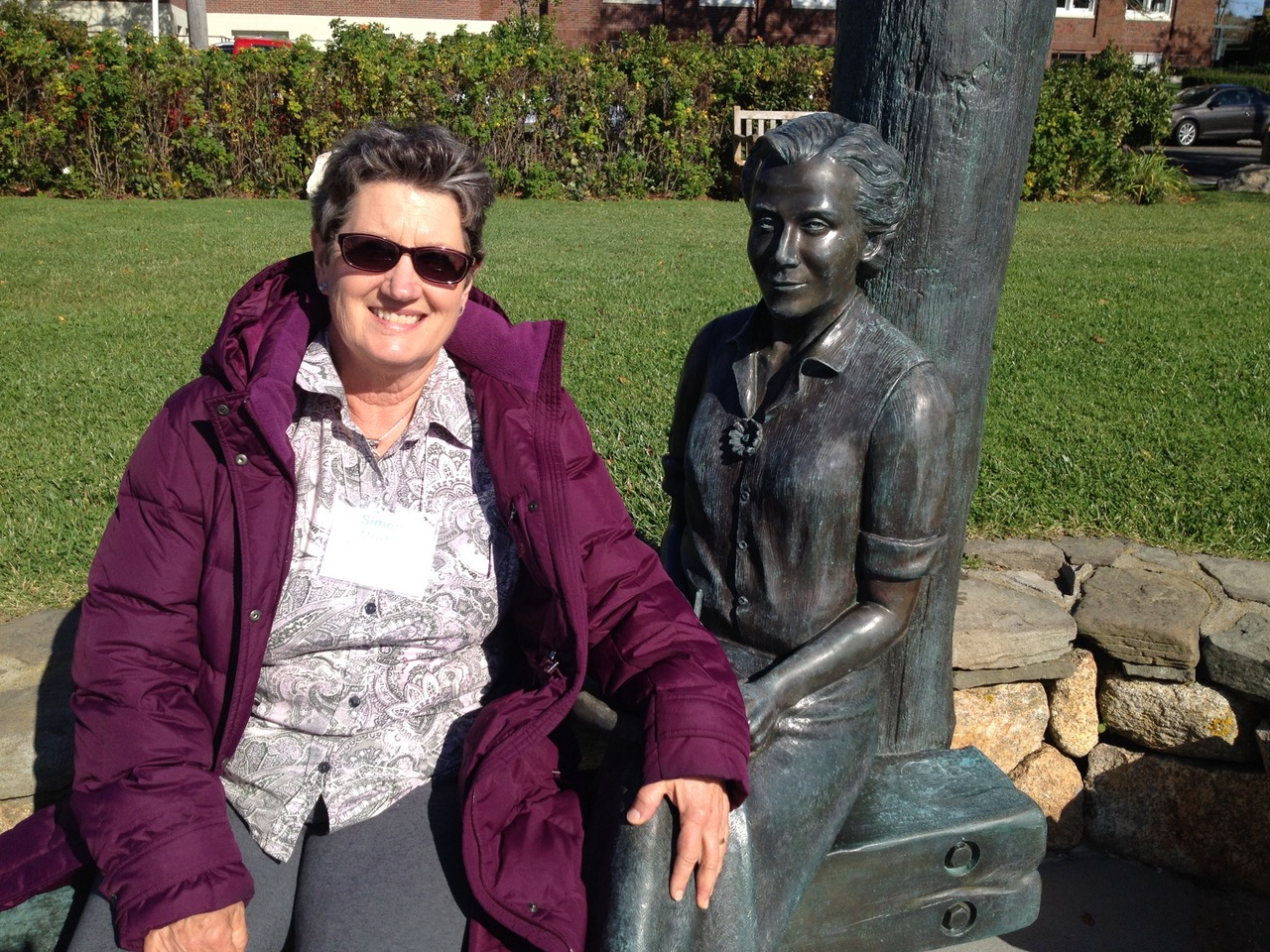
The National Network of Ocean and Climate Change Interpretation hasn’t witnessed much of the country’s history—we’ve only been here for about 6% of it—but that doesn’t mean we don’t have any knowledge or awareness of the past. Our community includes many members and collaborators who have witnessed the very environmental and social movements that helped pave the path for organizations like NNOCCI to exist. One of whom is Simone Mortan. We recently sat down to see what has inspired Simone over the years, how NNOCCI has played a role in her career, and what hopes she has for the future.
Simone is known to many in our community. Having trained multiple cohorts, from Study Circles to Framing the Conversation, Simone knows her way around a framing conversation. Her involvement in NNOCCI has been since its inception—Simone played a pivotal role in being one of the first trained in the collaboration between the New England Aquarium and Monterey Bay Aquarium, two of NNOCCI’s founding organizations. But her love of environmental education and desire to inspire future generations goes back to her own childhood.
Growing up in Oakland, California during the social environmental movements of the 60s and 70s, Simone remembers her first dive into environmental work fondly. At 16, she helped create perhaps the first curbside recycling program in the city. A neighborhood recycling cooperative, the program eventually involved 12 families, and it continued for a number of years until her generation headed off to university.
“Years later at the aquarium, we did an enrichment with the volunteer guides asking, ‘Where did your environmental activism start?’ ‘When was the first time you got involved?’” Simone reflected. “It made me go back and remember this. It was eye opening for me to think, man, I’ve been doing this a long time.”
Oakland during Simone’s youth was chalked full of social change and upward momentum. She remembers the rise of the Black Panther Party, the life and assassination of Martin Luther King Jr., and much more. The events of the world were nudging her toward her next steps before she even knew it. Simone started college at UC Berkeley as a high school senior—taking half days from school to head over to the college before eventually making the move to UC Santa Cruz and becoming a French major.
“I quickly realized that to be a French major, you had to read a lot of literature, and I wasn’t a big reader,” Simone recalled. “During a quarter where I just kind of casted about, I ended up in two classes—New Biology and Political Geography—where I had to write a paper. I eventually settled on how science was impacting the politics of the San Francisco Bay region. It’s what pushed me to environmental studies.”
Throughout her remaining college time, Simone worked at a number of science camps and in a classroom. Despite initially not wanting to become a teacher, she greatly enjoyed teaching, and stayed one more year to get her teaching credential. After numerous job applications, and an offer at school, she made a slight pivot and received a naturalist position with East Bay Regional Parks.
“It was being in the right place at the right time,” Simone said. “At that time, parks were dominated by men, but I got the job in the Berkeley Hills and spent five years there teaching and then helping open the park in Alameda.”
After working for Parks, Simone moved to the Monterey County Office of Education. There, she worked with homeschoolers and other alternative education students, many of whom she watched fall through the cracks of a broken system. The work was tough, but it didn’t slow Simone’s passion to educate young people. And it wasn’t long until she ended up where she needed to be.
For just shy of 25 years (up until her retirement) Simone worked at the Monterey Bay Aquarium. Her first 10 years involved storytelling within the programs and exhibits, while the last 15 were alongside the aquarium’s volunteer guide program.
“I went back to my interpretive roots,” Simone mentioned. “It felt like I had come home.”
The team’s dedication to conservation and helping people understand the connections between the ocean, the climate, and all of us resonated deeply with Simone. And with more liberty in her role among the guides, Simone, with her team of interpreters, was able to develop new enrichments, creating interactive and hands-on activities nearly every two weeks. From simple examples like using coloring sheets to show the temperature of the water off the bay to collaging how each individual remembers becoming environmentally aware, the enrichments supported not only the growth of the guides but those they came in contact with through their work.
NNOCCI was born out of a collaborative process between Monterey Bay Aquarium and the New England Aquarium, among others. Simone was a part of one of the first crosstrainings between the organizations and Frameworks Institute, creating curriculum for the “interpreter’s toolbox” as it was then called.
“During the training, Nancy Hotchkiss and I would sit out in the hallway of the hotel trying to process what we’d been taught that day,” Simone said. “They were teaching us how to use the frameworks and it was so contrary to what I had done before. I always thought if I taught them the science, they’ll get it. They’ll understand it and come around to my way of thinking. But we had done that for such a long time and it didn’t work.”
Like so many who have gone through NNOCCI’s training, Simone initially struggled to wrap her head around the various frameworks. But once she returned back to the west coast, she put it all into action. It worked.
“I did programs in the auditorium that were all about the aquarium’s deep sea research and started tying in how climate was impacting the ocean. How the ocean was key to it all. And I started to see heads nodding. I was thinking, ‘This stuff is working.’ I started using it everywhere I could.”
And she did. Simone continued using the practices she learned throughout the remainder of her years at the aquarium, and even taught for two semesters on Climate Justice and Communication at Cal State Monterey Bay. Simone has since retired, but she hasn’t stopped doing what she loves. Fiber art is now at the focus—weaving, spinning, dyeing, she’s done it all—but she also volunteers her time back at the aquarium providing climate communication training for the volunteer guides.
As July continues, we’ll share more resources and stories that offer inspiration and showcase resilience in our community, our country, and our world. Together, we can build a better future. All we need is a little bit of hope.
“We have to hold onto hope,” Simone says. “If you lose hope, you’re not going to take action. My hope is that the young people that I’ve influenced will be able to take what I’ve been able to offer and build upon it. I always found my hope looking at those kids. They are already having tremendous influence for the better.”
 Mobilizing High School Volunteers as Conservation AmbassadorsInformal science centers, like The Marine Mammal Center, serve as a valuable platform for connecting visitors with nature and inspiring positive environmental action towards climate change. Currently, only 17% of people in the US hear about climate change from someone they know once a month or more, establishing an unproductive spiral of silence on the topic of climate change.[READ MORE]
 The Importance of Community in Informal Science EducationAs members of NNOCCI, we all know about the importance of having a community to support our journey as educators. Having a professional community like NNOCCI is vital for our wellbeing and professional growth. A strong sense of community helps reduce isolation in roles that are often solo, temporary, or poorly defined. This can be particularly important when teaching about challenging subjects such as climate change. Being part of a community like NNOCCI can help strengthen professional identity in the field of informal education which often has fluid roles and career pathways.[READ MORE]
 “Ask a Scientist”“Ask a Scientist” by Richelle Tanner, March 26 2020 We had a great turnout for our “Ask a Scientist” interactive break-out session at the latest NNOCCI Virtual Conference, but there were so many questions that we didn’t get to! For those of you who couldn’t join us, we’re also summarizing the conversations that participants had with our [READ MORE]
 To Frame Climate Change, Lead with a Researched Value—Not a “Rogue” OneTo Frame Climate Change, Lead with a Researched Value—Not a “Rogue” One January 20 2017 This is the sixth post in a series about framing ocean and climate change. So, you want to motivate the public to take action to address climate and ocean change? One of the most important communications moves you can make is to open with a broad statement [READ MORE]
 Sharing Lessons Learned in Climate CommunicationSharing Lessons Learned in Climate Communication By Jake Trusheim After graduating from NNOCCI’s Crash Course in Effective Climate Change Communication, I felt inspired. I was equipped with the knowledge and skills to have more impactful climate change conversations, and I didn’t want that momentum to fizzle out. I heard the quote from Bill [READ MORE]